The KYE™ brand, in one place.
Master logo, indigo brand colour, charcoal ink, type, spacing and the misuse list. If anything you build references “KYE Protocol™” visually, it MUST trace back to this page. Designers, journalists, partners, integrators — bookmark it.


Two locked variants — colour & monochrome.
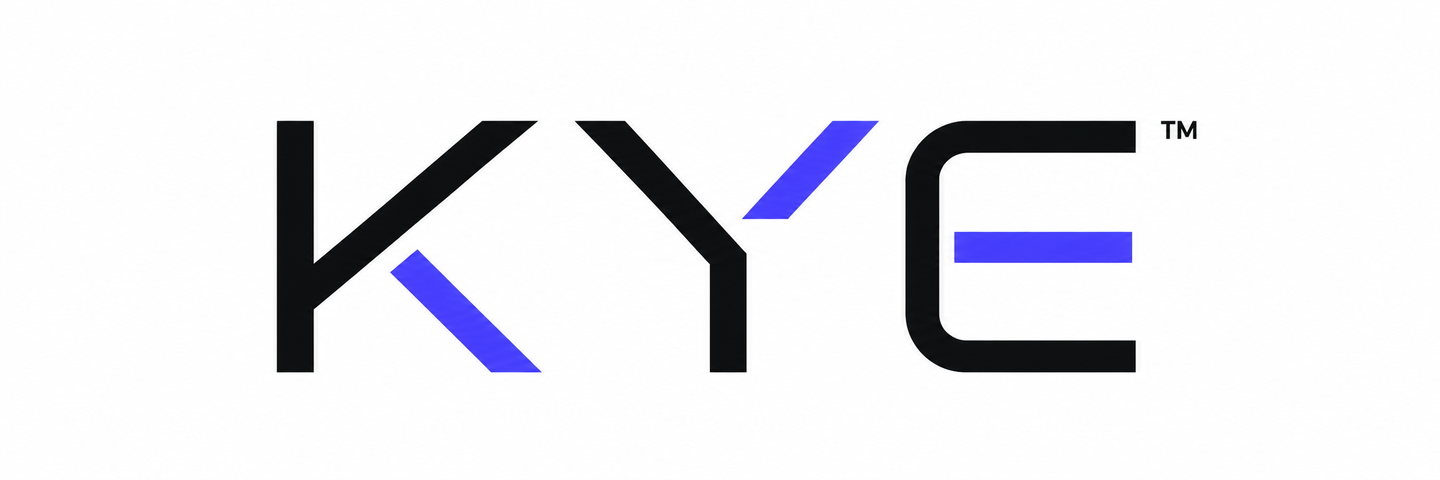
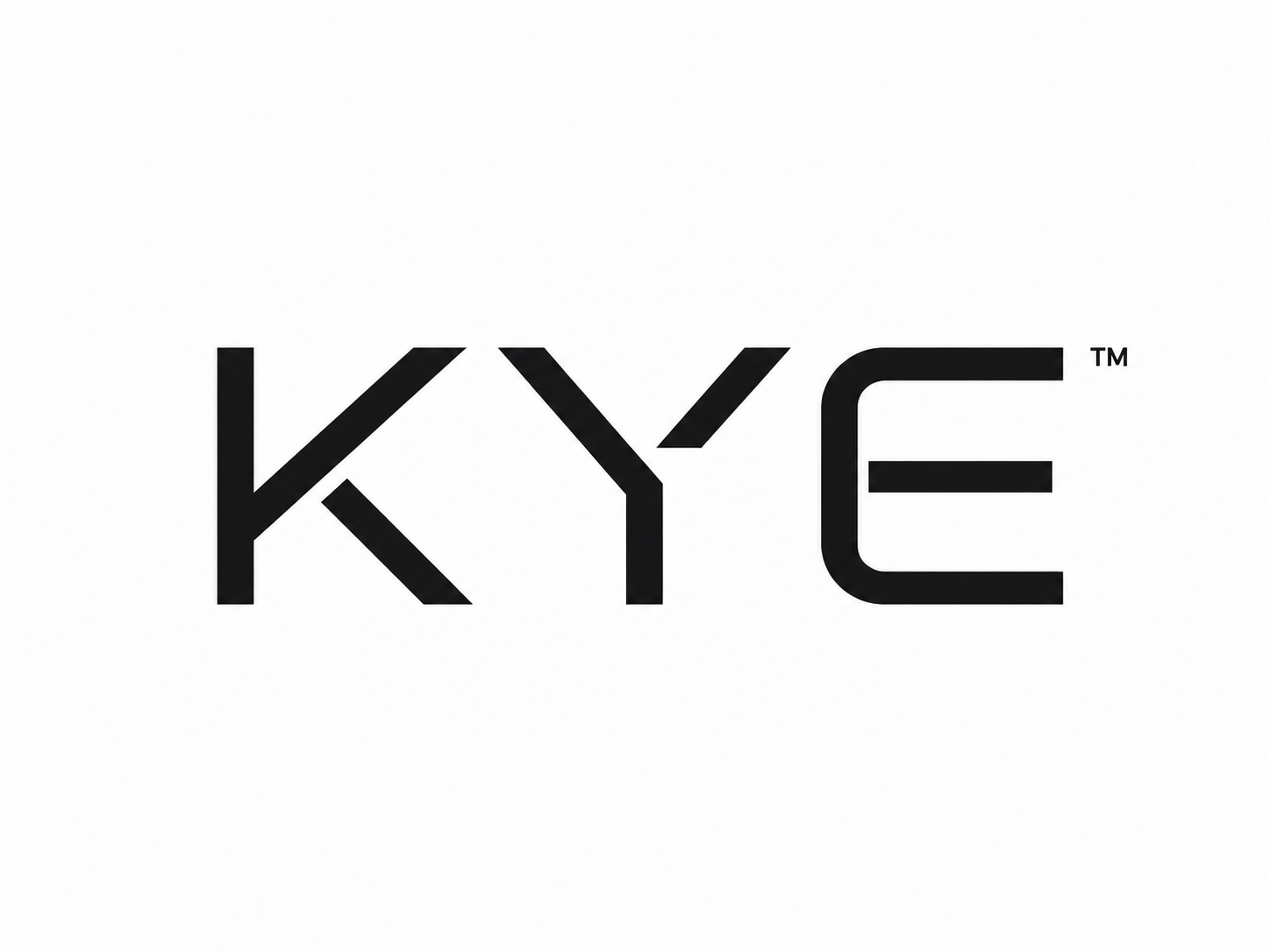
The KYE™ wordmark exists in exactly two approved variants. The colour variant is the default: charcoal letterforms with three indigo accent strokes — the lower diagonal of the K, the upper-right tip of the Y, and the middle bar of the E. The monochrome variant drops the accents and is reserved for single-colour reproduction (print, embossing, watermark). The trademark superscript sits flush with the cap height of the E. Do not redraw, condense, recolour, outline, drop-shadow, or composite either variant.
Clear space
Minimum clear space around the mark = the height of the E bar (≈ 1/6 of the cap height). Treat that as a non-negotiable margin against type, edges and other graphics. Do not crop the mark below 24 px tall — below that, use the favicon glyph (K on a #6366f1 tile).
block Misuse
- Don't change the colours of the accent strokes (only indigo
#6366f1). - Don't recolour the letterforms to anything other than the charcoal ink or pure white (on dark).
- Don't apply a gradient, stroke, drop-shadow, glow, bevel or 3D rotation.
- Don't stretch / condense / italicise / outline the wordmark.
- Don't lock-up KYE™ with another company's logo.
- Don't place the mark on a busy photographic background — use the dark or light stage.
Indigo + charcoal ink, period.
Two brand colours, eight system colours. The indigo #6366f1 drives every brand chrome (buttons, links, hovers, focus rings, the diagonal strokes of the logo). The charcoal ink #0b0f1c drives every primary text surface and the logo letterforms. Anything else is a system colour and MUST come from a token, never a magic hex.
Brand colours
Dark-mode brand
Semantic system colours
#6366f1 or a documented tint/shade of it. If you find a magic blue hex in any commit, file it as a violation and replace with a token reference.
System stack, two weights.
No custom webfont — the UI stack is the system-UI stack, with optical sizing for headlines. Material Symbols Outlined for iconography. No other typefaces.
font-variant-numeric: var(--type-numerals-tabular, tabular-nums).Tokens only. No magic hexes.
All KYE™ surfaces read brand values from /assets/css/tokens.css. A hardcoded brand hex anywhere outside that file is a violation and blocks CI under the tokens-leak guard.
/* good */
.btn-primary { background: var(--kye-color-brand); color: white; }
a            { color: var(--accent); }

/* bad — would block CI */
.btn-primary { background: #6366f1; }
a            { color: #4338ca; }
Master token file
The single source of truth is /assets/css/tokens.css. The :root block holds light values; :root[data-theme="dark"] mirrors the same names in dark-mode hexes. Components reach for var(--kye-*) exclusively.
Trademark mark
Every first-prominent use of KYE™, KYE Protocol™, Know Your Entity™, and KYE-* profile names on a public page MUST carry a literal unicode ™ (U+2122) directly after the term — no wrapping span, no inline style, no per-surface CSS rule. The ™ inherits font from its parent and renders flush against the term. Subsequent uses on the same page may drop the mark. (Updated 2026-05-15 — previous <span class="tm"> convention retired by the single-block wordmark refactor.)
Built something that uses the KYE™ mark?
Tell us about it. We'll add the listing to the Connector Directory and review the brand application.